


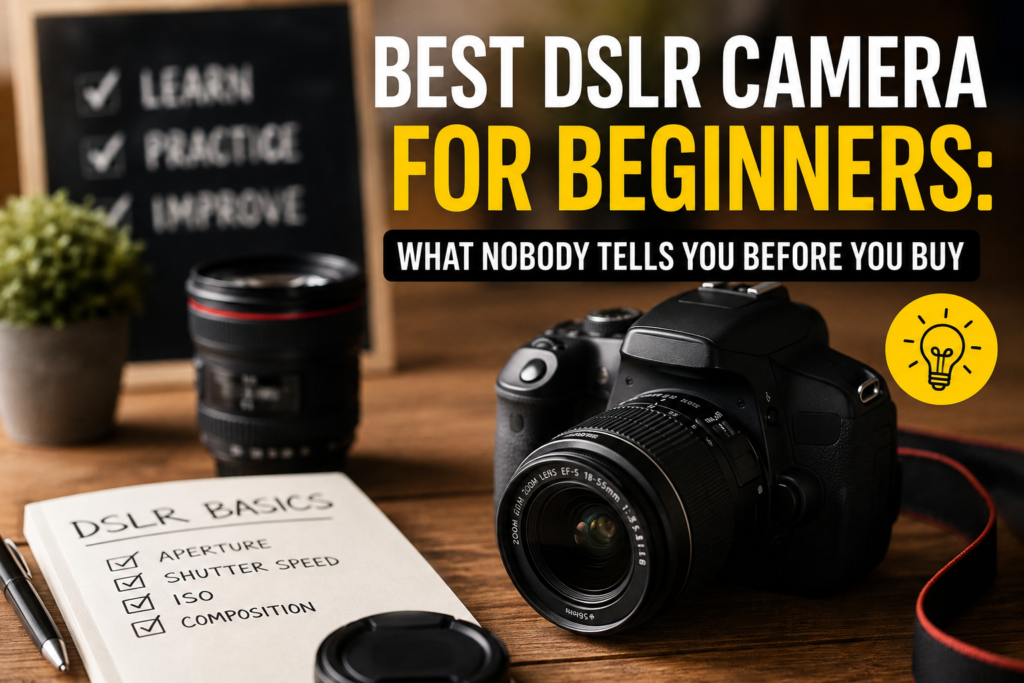
Let me be real with you for a second. When most people start looking for their first DSLR, they get stuck in a spiral of YouTube reviews, Reddit threads, and spec sheets that start blurring together after the first thirty minutes. Everyone has an opinion. Everyone is pushing something. And by the time you close your laptop, you are more confused than when you started.
So this article is going to be different. No fluff. No fake rankings pretending every camera is a winner. Just a clear, honest breakdown of the best DSLR cameras for beginners in 2026, what actually matters when you are just starting out, and how to make a decision you will not regret in six months.
Whether you are a high school student wanting to get into photography, a parent tired of blurry phone shots at your kid’s soccer games, or someone who just wants to understand how a real camera works, this guide was written for you.
Why People Still Buy DSLR Cameras in 2026
Here is the honest truth about DSLRs in 2026. The camera industry has mostly moved on to mirrorless. Canon, Nikon, and Sony are all pushing their mirrorless systems hard. They are not making new DSLR bodies anymore. And yet, DSLRs are still flying off shelves, both new and used, and for very good reasons.
First, the battery life on a DSLR is genuinely impressive. You can get anywhere from 700 to 1,500 shots on a single charge depending on the model. Mirrorless cameras chew through batteries because their electronic viewfinders and screens are always pulling power. A DSLR uses an optical viewfinder, which means you are literally looking through glass and mirrors at the real world, not at a tiny screen. That costs almost zero battery. For a beginner who forgets to charge things, this is a huge deal.
Second, the lens situation is incredibly beginner friendly. Because DSLRs have been around for decades, there are thousands of lenses available for Canon EF and EF-S mounts, and for Nikon’s F-mount. Many of these lenses can be found used for very little money. A 50mm f/1.8 lens for a Canon DSLR can be picked up secondhand for around thirty to forty dollars, and it will produce photos that look completely professional. That kind of value is nearly impossible to find in the newer mirrorless ecosystems.
Third, and this is the one people overlook most often, DSLRs actually teach you photography better than most modern cameras. The physical controls, the optical viewfinder, and the slightly slower shooting experience force you to slow down and think about what you are doing. You cannot rely on fancy electronic features to do the work for you. When you finally understand why your photo looks the way it does, you will understand photography in a way that makes you a better photographer on any camera.
Are there downsides? Of course. DSLRs are heavier and bulkier than mirrorless. The autofocus in video mode is not great on most beginner models. And if you want cutting-edge features like real-time exposure preview or super-fast subject tracking, mirrorless is a better fit. But for someone who genuinely wants to learn how photography works while getting great images without spending a fortune, a DSLR in 2026 is still one of the smartest choices you can make.
What to Actually Look for in a Beginner DSLR
Before jumping into the specific cameras, you need to know what actually matters for beginners so you are not paying for things you do not need.
Sensor size and megapixels. Every beginner DSLR you will find in 2026 uses what is called an APS-C sensor. This is smaller than a full-frame sensor (used in professional cameras) but still massively better than any phone camera. You do not need to obsess over megapixels. A 24-megapixel image from a beginner DSLR is already more resolution than most people will ever need. It will print beautifully up to very large sizes and crop well if you need to tighten a frame.
Autofocus system. This matters more than most beginners expect. Entry-level DSLRs typically have 9 to 11 autofocus points. That is enough for portraits, street shots, landscapes, and casual sports. Where it starts to show limits is with very fast, unpredictable action. If you are planning to shoot football or wildlife, a mid-range body will serve you better. For everything else, basic autofocus works fine.
Guide modes and beginner features. Some cameras have built-in teaching tools. Nikon calls theirs Guide Mode. Canon has something called the Feature Guide. These walk you through what different settings do in plain language, right there on the camera screen. For someone who is still figuring out what aperture and shutter speed actually mean, this kind of help is worth more than any spec upgrade.
Weight and grip. A camera that feels uncomfortable in your hands will end up in the closet. Seriously. Weight and grip design directly impact how often you practice. Heavier professional bodies are not better for beginners because they get left behind on trips and outings. A camera you bring everywhere will teach you more than a fancier one you leave at home.
Battery life. Nothing stops a learning session faster than a dead battery. Any decent DSLR will last a full day of casual shooting, but check the official shot count rating before you decide.
Budget. You do not need to spend a lot. In 2026, the sweet spot for a beginner DSLR kit (body plus an 18-55mm kit lens) sits between three hundred and five hundred dollars, especially if you are open to buying used or refurbished.
The Best DSLR Cameras for Beginners in 2026
Canon EOS Rebel T7
If you walked into a camera store today and asked for the most reliable, affordable, and beginner-friendly DSLR available, there is a very good chance the person behind the counter would hand you the Canon EOS Rebel T7. It has dominated Amazon’s bestseller lists in the camera category for years, and that popularity is not accidental.
The T7 packs a 24.1-megapixel APS-C sensor that produces genuinely sharp, detailed photos in good light. Colors are accurate and pleasing right out of the camera. The body is small and lightweight at about 1.75 pounds with the battery and card, and the rubber grip on the front gives you a solid hold without fatigue. It ships with the EF-S 18-55mm f/3.5-5.6 IS II lens, which covers a very useful range for everyday shooting, from wide angles for landscapes to moderate telephoto for portraits.
One of the T7’s best features for beginners is the built-in Feature Guide. When you hover over a setting or mode, the camera gives you a plain-English explanation of what it does and why you might use it. Instead of digging through a manual or watching a tutorial, you can learn directly from the camera itself while you shoot.
The nine-point autofocus system is basic but honest. It focuses quickly on stationary subjects and handles moving people well enough in normal situations. Battery life comes in around 500 shots per charge from Canon’s official rating, and many users report getting closer to 600 or 700 in real-world use. Built-in Wi‑Fi lets you transfer photos to your phone or control the camera remotely, which is handy for self-portraits and group shots.
Where the T7 falls short is video. It only shoots Full HD at 1080p with no 4K option. The screen does not tilt, and there is no touchscreen. Autofocus in video mode is sluggish. If video is a priority, this camera will frustrate you. But for still photography, it is a completely capable teaching tool that can produce photos you will be proud to share.
The T7 is available new for around 450 to 500 dollars with the kit lens. Used bodies in good condition can be found for well under two hundred dollars, making it one of the most accessible entry points into real photography.
Nikon D3500
The Nikon D3500 is arguably the best pure beginner DSLR ever made. Nikon has discontinued it, so you will need to hunt for it on the used market, but it is absolutely worth tracking down.
What makes the D3500 so special is a combination of things that are rarely found together at this price point. The 24.2-megapixel sensor with no anti-aliasing filter delivers razor-sharp detail, maximizing the sensor’s resolution potential. The image quality is outstanding, punching well above what you would expect from an entry-level body.
The Guide Mode on the D3500 is the best beginner teaching tool available on any DSLR. It literally asks you what kind of photo you want to take, shows you which settings to use, and then explains why those settings work the way they do. It is the closest thing to having a photography teacher built into your camera. More than just automated settings, it explains the logic behind them, which means you are actually learning while you shoot instead of just letting the camera do everything for you.
Battery life is where the D3500 absolutely shines. Nikon rates it at 1,550 shots per charge on a single EN-EL14a battery. That is genuinely exceptional. You could shoot an entire multi-day trip without touching a charger. For beginners who are just starting to explore photography, this kind of reliability removes one of the most common frustrations early on.
The body design is thoughtful. The grip is deep and comfortable, the controls are laid out logically, and the camera does not feel fragile. At 365 grams without lens, it is also notably light for a DSLR, making it comfortable to carry around your neck for long stretches.
The downsides are real but manageable. There is no Bluetooth or NFC for wireless transfers. The screen is fixed and cannot be tilted. Continuous shooting tops out at five frames per second, which is decent but not fast. And like the T7, the D3500 does not shoot 4K video.
Because the D3500 is discontinued, prices on the used market are usually very good. A well-cared-for body with a kit lens typically runs in the range of two hundred to three hundred dollars. For that money, it offers extraordinary value and remains one of the highest-rated beginner DSLRs ever reviewed by photography publications.
Canon EOS Rebel SL3 (EOS 250D)
If size matters to you, the Canon EOS Rebel SL3 is the camera to look at. It holds the title of the smallest and lightest DSLR body ever made, measuring just 122mm wide, 93mm tall, and 70mm deep, and weighing only 449 grams with the battery inside. This is a camera that disappears into a bag and does not make your neck ache after a full day of shooting.
But the SL3 is not just a smaller T7. It comes with some meaningful upgrades that make it worth the slightly higher price. The screen is fully articulating, meaning you can flip it out and tilt it in almost any direction. This makes shooting from low angles, over-the-head shots, and video recording dramatically easier. The screen is also a touchscreen, so you can tap to focus, tap to take a shot, and navigate menus with your finger instead of pressing buttons.
The SL3 also adds 4K video recording, which the T7 does not offer. The 4K does come with a crop, so the field of view narrows a bit when you switch into that mode, but for beginners who want good video alongside great photos, this makes the SL3 a much more versatile tool. The on-sensor phase-detection autofocus also works noticeably better in Live View and video mode than the T7’s contrast-detection system.
Image quality comes from a 24.1-megapixel APS-C CMOS sensor paired with a DIGIC 8 processor, the same processor found in several of Canon’s more expensive cameras at the time of its release. Colors are warm and rich, and the camera handles mixed lighting very well. High ISO performance is solid up through ISO 3200 before noise becomes obvious, and the ISO 6400 setting is still usable in a pinch.
The battery life is lower than the D3500, rated at around 1,070 shots per charge, which is still very good. And the camera gains access to Canon’s enormous EF and EF-S lens ecosystem, with decades of options spanning from budget kit lenses to professional-grade glass.
For beginners who care about portability, video capability, and a modern shooting experience, the SL3 is possibly the smartest DSLR buy you can make in 2026. It regularly goes on sale in the range of 550 to 650 dollars with the kit lens.
Canon EOS 80D (For Beginners Who Want Room to Grow)
If you are serious about learning photography and you want a camera that will not feel limiting within the first year, the Canon EOS 80D is worth stretching your budget for. It is not the cheapest option on this list, but it is the one that gives you the most room to grow.
The 80D features a 45-point all-cross-type autofocus system, which is dramatically better than the nine or eleven points found in the entry-level bodies. It also introduces a dedicated top LCD panel, a rear command dial, and an AF area selection lever that let experienced shooters work faster and more intuitively. For a beginner, these things will not mean much on day one. But by month six, when you start shooting in manual mode regularly, you will be very glad you have them.
The image quality is excellent thanks to a 24.2-megapixel APS-C sensor and the DIGIC 6 processor. The Dual Pixel CMOS autofocus system makes Live View and video shooting smooth in a way that basic contrast-detection cannot match. And the magnesium alloy body with weather sealing means the 80D can handle light rain and dusty environments that would make you nervous with a plastic entry-level body.
The 80D is available used at prices that have dropped considerably as people upgrade to mirrorless. It is not unusual to find a clean, low-shutter-count 80D body for around four hundred to five hundred dollars, which puts a professional-grade APS-C camera well within beginner reach.
Understanding the Exposure Triangle Before You Shoot
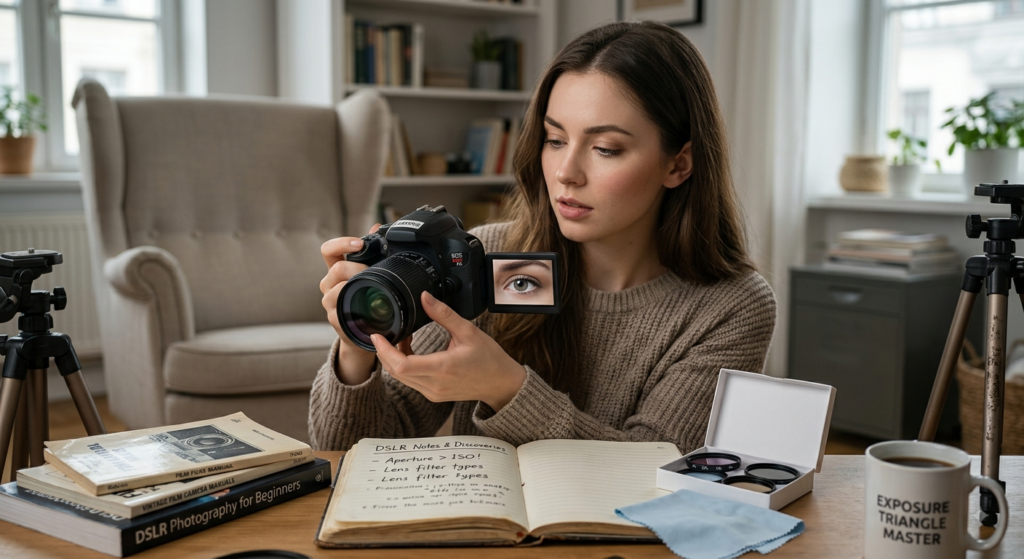
Getting a DSLR means nothing if you keep it in Auto mode forever. The camera is designed to give you control, and understanding three basic concepts will change how you see and make photos.
Aperture controls how much light enters the lens and how much of your scene is in focus. It is measured in f-stops like f/1.8, f/5.6, or f/11. A low f-number means the lens opening is wide, which lets in more light and creates a blurry background (that look people call bokeh). A high f-number closes the lens down, lets in less light, and keeps more of the scene sharp from front to back. Portraits typically use low f-numbers like f/1.8 or f/2.8. Landscapes usually call for something like f/8 or f/11.
Shutter speed controls how long the camera sensor is exposed to light. It is measured in fractions of a second, like 1/250 or 1/1000. A fast shutter speed freezes motion, which is what you want when photographing a running dog or a jumping athlete. A slow shutter speed creates motion blur, which can be artistic or just annoying depending on your subject. If you are shooting handheld without any stabilization, keeping your shutter speed above 1/60 of a second prevents camera shake from blurring your shots.
ISO is the camera sensor’s sensitivity to light. Low ISO numbers like 100 or 200 produce the cleanest images with the least grain, and they work great in bright conditions. Higher ISO numbers like 800, 1600, or 3200 are used in dark environments but add digital noise, which looks like grain or speckle in your images. The goal is always to use the lowest ISO you can get away with while still getting a properly exposed photo.
These three settings work together like a three-way balancing act. Changing one usually requires adjusting at least one of the others. This relationship is called the exposure triangle, and once you genuinely understand it, you can walk into any lighting situation and know exactly which settings to start with. Most beginners spend their first month or two shooting in Aperture Priority mode, where you set the aperture and let the camera handle shutter speed automatically. It is a smart middle step between full auto and full manual.
Tips to Make the Most of Your First DSLR
Buying the camera is just the beginning. What you do with it in the first few weeks determines whether photography becomes a real skill or just a phase. Here are the things that actually move the needle.
Shoot in RAW format if your camera supports it. JPEG files are compressed and processed in-camera, which limits how much you can fix later during editing. RAW files preserve all the information the sensor captured, giving you far more flexibility when you process images on a computer. Every beginner DSLR on this list supports RAW shooting.
Get off Auto mode as soon as you feel ready. Start with Aperture Priority mode and practice changing your f-stop to see how it changes the background blur and sharpness of your photos. Once that feels natural, try Shutter Priority for situations with movement. Then eventually push yourself into full Manual mode. It feels hard at first and then suddenly clicks.
Shoot every single day if you can, even just for ten minutes. The fastest way to improve is repetition. Take the same photo multiple times with different settings and compare them on your computer screen afterward. This is how you build intuition for what works.
Learn to use the histogram on your camera’s screen. The histogram is a graph that shows you how the tones in your image are distributed from dark to light. If the graph is piled up on the left edge, your image is underexposed. If it is crashing into the right edge, it is overexposed. Learning to read the histogram rather than just looking at the screen (which can be misleading depending on ambient light) will save countless photos.
Invest in a second lens before you invest in a second body. The glass you shoot through has a more dramatic effect on your image quality than the camera body itself. A 50mm f/1.8 prime lens is the single most recommended upgrade for beginner DSLR users. It is cheap, sharp, and produces beautiful portrait images with creamy background blur that your kit lens simply cannot achieve.
Should You Buy New or Used?
This comes up constantly, and the honest answer is that the used market is your best friend as a beginner. DSLR cameras are durable pieces of equipment. A used D3500 or Canon T7i in excellent condition will photograph just as well as it did on day one, and it will cost you significantly less. Look for sellers who disclose the shutter count, because camera shutters are rated for a specific number of cycles and knowing where a used body sits on that count tells you how much life is left.
Websites like MPB, KEH Camera, and Amazon’s certified refurbished listings are reliable places to find used DSLRs with some form of guarantee. Local camera shops that sell used gear are also worth visiting, since you can handle the camera before buying and ask questions.
If you are buying new because you want a warranty and peace of mind, that is a completely reasonable choice. The Canon EOS Rebel T7 and the Canon EOS Rebel SL3 are both still available brand new in 2026 and come with manufacturer warranties that protect your investment for the first year.
The Bottom Line
The best DSLR camera for a beginner is not necessarily the one with the most megapixels or the longest feature list. It is the one that fits comfortably in your hands, fits honestly within your budget, and motivates you to actually pick it up and shoot.
If budget is your primary concern, a used Nikon D3500 or Canon Rebel T7 will give you everything you need to learn photography properly. If you want a newer camera with better video capability and a modern touchscreen, the Canon EOS Rebel SL3 is the strongest all-around beginner DSLR available today. And if you are the kind of person who buys things once and wants to keep them for years, spending a bit more on a used Canon EOS 80D sets you up with a body that will still feel capable when your skills have advanced significantly.
Whatever you choose, commit to learning the camera you buy. Read about it. Practice with it. Make mistakes with it. No camera will make you a good photographer automatically, but any of the cameras on this list will give you everything you need to become one.




One Response