


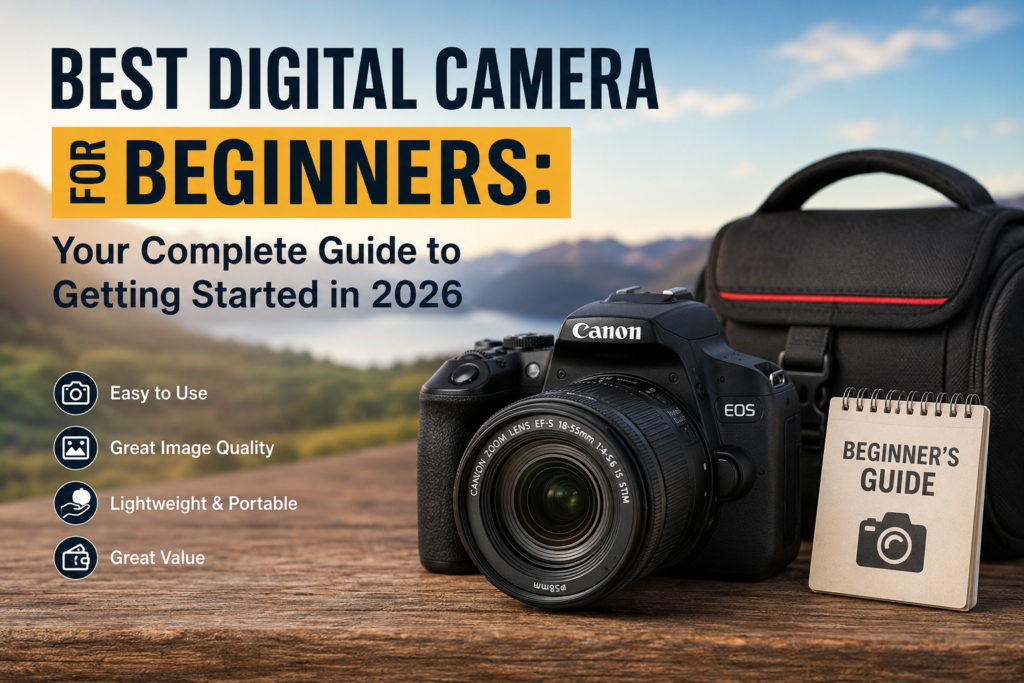
There is something different about picking up a real camera for the first time. Your phone takes decent photos, sure, but there is a feeling you get when you wrap your hands around an actual camera body, look through a viewfinder, and press that shutter. Suddenly photography feels intentional. It feels like something you are actively doing rather than something happening automatically in your pocket.
If you have been searching for the best digital camera for beginners, you have probably noticed that every website throws a list of models at you with confusing specs and almost no explanation of what any of it actually means for a person who is just starting out. This guide is different. We are going to walk through exactly what matters, what does not, which cameras are genuinely worth your money in 2026, and what mistakes will cost you if you skip this kind of research before buying.
Why Buying a Dedicated Camera Still Makes Sense in 2026
Smartphones have gotten incredibly capable over the last few years, and there is no point in pretending otherwise. But a dedicated digital camera still has clear advantages that a phone cannot replicate. The sensor inside even a basic mirrorless or DSLR camera is physically much larger than the tiny chip inside a phone. That larger sensor captures more light, which means your photos in dimly lit restaurants, evening events, or shaded outdoor spaces will look dramatically cleaner and sharper.
You also get real optical zoom, which is entirely different from the digital pinch-to-zoom your phone offers. Optical zoom uses actual glass to bring a subject closer without destroying image quality. Beyond that, a camera with interchangeable lenses gives you creative control that no phone can match. You can put on a wide-angle lens for landscapes, swap to a portrait lens for crisp close-up shots of people, and grow your gear as your skills develop.
Perhaps most importantly, using a dedicated camera forces you to slow down and think about what you are shooting. That intentionality is how you actually get better at photography.
What Actually Matters When Choosing Your First Camera
Most beginner guides lead with megapixels. That is mostly a waste of your attention. Here is what genuinely matters when you are buying your first camera.
Sensor Size
The sensor is the heart of the camera. For beginners in 2026, you want either an APS-C sensor or a Micro Four Thirds sensor. Both deliver image quality that would have been considered professional grade just five years ago. Full-frame sensors are larger and technically superior, but they also double the cost of every lens you buy. You do not need full-frame as a beginner, and spending money there is one of the most common rookie mistakes.
Autofocus Performance
When you are first starting out, you will miss shots because of technique, timing, and framing. A camera with reliable autofocus at least removes one variable from that list. Modern beginner cameras include face detection and eye detection, meaning the camera locks onto your subject’s eyes automatically. For portraits, family photos, and even moving subjects, this is the feature that saves the most shots.
Ease of Use
A camera that frustrates you will end up sitting on a shelf. Look for touchscreens, logical menus, and beginner modes that explain what each setting does rather than just labeling it with a number. Some cameras include built-in guides that walk you through adjustments as you make them, which is genuinely useful when you are still learning the difference between aperture and shutter speed.
Lens Ecosystem
The body you buy today is really a commitment to a lens system. Canon’s RF mount, Sony’s E mount, and Nikon’s Z mount all have different selections of lenses at different price points. If you eventually want to add a portrait lens or a wider zoom, you want the system you start with to have affordable options waiting for you.
Battery Life and Portability
If your camera is heavy or runs out of battery after an hour, you will leave it at home. The best beginner camera is the one you actually carry with you. Size and battery performance matter far more in real life than they do on a spec sheet.
Understanding Camera Types Before You Buy
Mirrorless Cameras
Mirrorless cameras are where the industry has moved in 2026. They are lighter, quieter, and faster than traditional DSLRs, and they offer better autofocus systems because the camera can use its sensor to track subjects continuously. The electronic viewfinder shows you a live preview of how your photo will look before you take it, which is a genuine learning tool when you are trying to understand exposure. For most beginners today, a mirrorless camera is the right starting point.
DSLR Cameras
Digital Single Lens Reflex cameras use a physical mirror system and an optical viewfinder. They are older technology, but that does not make them bad cameras. A used DSLR from a reputable brand gives you incredible image quality for a very low price, and many photographers swear by the way DSLRs feel in the hand. If your budget is tight or you like the idea of starting with something more traditional, a DSLR remains a perfectly viable choice.
Point-and-Shoot Cameras
Point-and-shoot cameras are compact, simple, and easy to carry. They are ideal if you want something better than your phone without any of the complexity of interchangeable lenses. The trade-off is that you cannot change lenses as your skills grow, and the image quality at low price points is closer to a smartphone than to a mirrorless camera. That said, for casual travel photography or family snapshots, they get the job done with minimal learning curve.
Bridge Cameras
Bridge cameras sit between point-and-shoots and mirrorless cameras. They offer large built-in zoom lenses (sometimes 40x or more) and more manual controls, without the cost of a lens ecosystem. They are a solid pick if telephoto reach is your priority and you want one camera that does everything without swapping glass.
The Best Digital Cameras for Beginners in 2026
After reviewing hands-on testing from multiple photography publications, forum discussions from thousands of real users, and side-by-side spec comparisons, these are the cameras that stand out as the best options for anyone starting their photography journey this year.
Canon EOS R50 with RF-S 18-45mm (Best Overall)
If you ask most photography experts to name a single camera they would recommend to a complete beginner in 2026, the Canon EOS R50 comes up more than any other option. It packs a 24.2-megapixel APS-C sensor into a body that weighs just 375 grams, which is lighter than many textbooks. The Dual Pixel CMOS AF II autofocus system uses AI-based subject detection for people, animals, and vehicles, and it works with an accuracy that beginners tend to find genuinely confidence-building.
The fully articulating touchscreen is a detail that matters more than it sounds. You can flip it out to shoot low to the ground, angle it forward for self-recording, or fold it away for protection when you are not using it. The menus are clean and approachable, and Canon’s Creative Assist mode actually explains settings in plain language rather than technical jargon.
The camera also records 4K video oversampled from a 6K readout, which means the footage is sharper than most cameras at this price point can produce. For a first-time buyer who wants to shoot both stills and video, the R50 handles both without compromise.
The kit lens that ships with it covers 18 to 45mm, which is a versatile range for everyday subjects including portraits, street scenes, and group shots. As your skills grow, Canon’s RF-S lens lineup gives you options to expand, though it is worth noting that the selection is smaller than Sony’s E-mount range.
Price range: Around $700 to $800 with kit lens.
Nikon Z50 II (Best for Learning Traditional Photography)
The Nikon Z50 II is the camera that feels most like a traditional photographer’s tool. It has a larger grip than the Canon, a metal top plate, dedicated dials that you can spin with your thumb and forefinger, and a solid build that makes it feel like something worth investing in. For beginners who want to learn photography the old-fashioned way, by understanding each setting and what it does, the Z50 II rewards that approach.
The autofocus has been significantly improved over the original Z50. It now carries AI-based subject tracking that keeps up with fast movement, and low-light autofocus sensitivity has been improved as well. The image quality is excellent, with Nikon’s color science producing tones that many photographers describe as looking natural and appealing straight out of the camera without heavy editing.
The one limitation worth knowing about is the screen. The Z50 II uses a tilting screen that moves up and down but does not flip forward, which makes it less convenient for vlogging or self-recording compared to the Canon. If you plan to shoot yourself on camera regularly, that is worth considering. But for landscape, travel, portrait, and general photography learning, the Z50 II is a genuinely excellent first camera.
Price range: Around $900 to $1,000 with kit lens.
Sony a6100 (Best for Video and Lens Selection)
Sony’s E-mount lens ecosystem is the largest of any mirrorless system in the world. When you buy into Sony, you are buying access to an enormous catalog of affordable third-party lenses from brands like Sigma and Tamron, which keeps upgrade costs lower than almost any competing system.
The a6100 itself features a 24-megapixel APS-C sensor, real-time eye autofocus that is remarkably reliable, and 4K video capability. Its ISO range extends slightly higher than the Canon EOS R50, giving it a marginal edge in very dim conditions. The body is small, light, and genuinely pocketable with the right lens attached.
The color science leans toward cool, clinical tones that some photographers prefer and others find flat. Sony’s menus are notoriously complex compared to Canon’s, so expect a steeper learning curve in terms of navigation. But once you figure out the layout, the camera rewards you with deep customization and exceptional autofocus performance.
This camera is especially well suited to beginners who know they want to shoot a lot of video content, whether for social media, YouTube, or personal projects.
Price range: Around $650 to $750 with kit lens.
Canon EOS Rebel T7 (Best Budget DSLR Under $600)
For beginners working with a tighter budget who still want a real camera with interchangeable lenses, the Canon Rebel T7 with its 18-55mm kit lens is one of the best values available right now. It uses a 24-megapixel APS-C sensor, shoots full HD video, and connects to Wi-Fi for easy photo transfers to your phone.
The handling is comfortable, the menus follow Canon’s clear and logical layout, and the sheer number of tutorials, YouTube videos, and photography guides that reference this camera makes it one of the easiest to learn on. When you hit a problem or want to try something new, there is almost certainly a guide online walking you through it.
The autofocus is slower than modern mirrorless options, and 4K video is not available at this price. But for still photography, portraits, and outdoor shooting where you have good light, the Rebel T7 produces excellent photos and will not leave you feeling like you need an upgrade for at least a few years.
Price range: Around $450 to $550 with kit lens.
Fujifilm X-M5 (Best for Color, Style, and Creative Shooting)
Fujifilm makes cameras that feel different from everything else on this list, and many photographers love them for exactly that reason. The X-M5 is a small, stylish mirrorless body with physical dials that snap satisfyingly into place and a menu system that feels closer to a traditional film camera than a digital one.
What Fujifilm is most famous for is its film simulations. These are built-in color profiles that mimic the look of classic film stocks. Whether you want the warm tones of Velvia slide film or the muted, desaturated look of Acros black and white, the camera produces gorgeous images straight out of the device without any editing. For beginners who find post-processing overwhelming, this is a genuine advantage because you can share a beautifully processed photo moments after taking it.
The X-M5 also shoots 6K video and is compact enough to carry comfortably in a jacket pocket with a pancake lens attached. The lens ecosystem is solid and includes some of the most beautifully designed glass in the market.
Price range: Around $800 to $900 with kit lens.
How Much Should You Actually Spend?
The budget question is one that trips up a lot of first-time buyers, and the honest answer is probably not what you expect.
Spending too little is a real risk. Cameras in the $150 to $250 range often have autofocus so slow that you will miss most of the moments you are trying to capture, and image quality in anything other than bright outdoor light tends to be disappointing. Buying something that frustrates you from week one is not a good way to start a photography hobby.
But spending too much is equally wasteful. You do not need a $3,000 professional body to learn photography. A skilled photographer with a $600 camera produces better images than a beginner with a $3,000 body, because the skills matter more than the gear at the start.
The sweet spot for most beginners sits between $500 and $900. In this range, you get an APS-C mirrorless or DSLR body with a kit lens that covers everyday focal lengths, reliable autofocus, and good image quality in a wide range of conditions. You will not outgrow a camera in this range for several years, assuming your skills are still developing.
If your budget is tighter, buying a used camera from a reputable dealer like B&H Photo, KEH, or MPB can get you the same performance for 30 to 40 percent less. Camera bodies depreciate relatively quickly, and a two or three year old model from a respected brand is often nearly identical in real-world performance to the current version.
Mistakes That Will Cost You Money and Regret
Buying the most expensive camera you can afford. More money does not make better photos. Skill, light, and composition make better photos. A $700 mirrorless camera in good light, used by someone who understands the exposure triangle, will produce images indistinguishable from a $4,000 professional body for the vast majority of subjects.
Spending everything on the body and nothing on the lens. Lenses have more impact on image quality than camera bodies. If you have $900 to spend total, spending $600 on a body and $300 on a quality prime lens will get you better results than spending $800 on a body and $100 on a cheap zoom.
Ignoring used equipment. The photography gear market is mature and reliable. Buying used from a reputable dealer almost always saves significant money with virtually no trade-off in performance. Do not let the idea of “used” make you automatically reach for new when the used version is identical.
Choosing based on brand loyalty. The days when Canon was clearly better than Nikon or Sony were clearly superior to both are over. Modern cameras from all major brands are genuinely excellent. Choose based on your specific needs, your budget, and the lens ecosystem, not based on which brand your favorite photographer uses.
Expecting professional results immediately. Photography is a skill. The first several weeks with any camera are about learning how the settings interact, how light behaves, and how to anticipate the moment you want to capture. Early photos that disappoint you are normal and expected. Every photographer whose work you admire made thousands of bad photos before making good ones.
What to Buy Alongside Your First Camera
The camera body is only the beginning. A few accessories will make your experience dramatically better from day one.
Memory Cards: Buy a name-brand memory card with a high write speed. Sandisk and Lexar are reliable choices. Avoid the cheapest generic options, as slow cards cause your camera to pause between shots while it writes data.
Extra Battery: Most kit cameras ship with a single battery that lasts a few hundred shots. Buy a second one before your first big shoot, because running out of power mid-day is genuinely frustrating.
Camera Bag or Strap: A comfortable strap keeps your camera accessible and safe. A small bag protects it during travel and makes carrying the kit lens plus one extra lens manageable without stress.
Lens Cleaning Kit: Dust and fingerprints happen. A basic blower brush and lens cloth prevent smudges from permanently affecting your shots.
Skip the filters, the ring lights, the tripods, and the extra lenses for now. Add those as you develop specific needs rather than guessing what you will want before you have shot enough to know.
DSLR or Mirrorless: The Honest Answer for 2026
For most people buying their first camera today, a mirrorless system is the better choice. The autofocus is faster and more accurate, the bodies are lighter and more compact, and the technology is where manufacturers are actively investing. When you buy into mirrorless, you are buying into a system that will receive new lenses, software updates, and continued development for years ahead.
That said, a used DSLR remains a genuinely strong option if your budget is under $400. The image quality from a four or five year old Canon Rebel or Nikon D3500 is still excellent. If your goal is to learn photography fundamentals without spending much, a used DSLR with a 50mm prime lens is one of the best combinations available.
The only clear reason not to choose mirrorless at this point is price. If the budget genuinely cannot stretch to a modern mirrorless kit, a used DSLR beats an underpowered mirrorless compact every time.
Final Thoughts
Picking your first digital camera does not have to be complicated, but it does require some honest thinking about what you actually want to do with it. A travel photographer needs something different from a portrait shooter. Someone who wants to make YouTube videos needs different features than someone photographing their family at weekend events.
Start by narrowing down your shooting scenarios. Then choose a camera that solves those specific problems without overspending on features you will never use.
Based on everything available in 2026, the Canon EOS R50 is the single easiest camera to recommend to the widest range of beginners. It is light, approachable, sharp, and capable of growing with you for several years. If you want more of a traditional feel and are willing to spend slightly more, the Nikon Z50 II is an outstanding alternative. And if you plan to shoot a lot of video or want access to the broadest lens selection possible, Sony’s ecosystem through the a6100 or ZV-E10 II gives you the most room to grow.
Whatever you choose, the most important thing is to start shooting. The camera sitting in your bag is not taking any photos. Even with an imperfect first choice, the hours you spend practicing, experimenting, and occasionally getting it wrong are what separate photographers who keep improving from those who give up after a month.
Photography rewards patience, curiosity, and consistent practice far more than it rewards expensive equipment.


2 Responses