There is a moment that happens to a lot of people. You pull out your phone to take a photo of something that genuinely matters, a sunset that felt cinematic, a friend laughing in the right light, a meal that looked almost too good to eat, and the photo comes back looking nothing like what you saw. The colors are slightly off. The background is a mess. The whole thing just feels flat. And you know, somewhere in the back of your mind, that the moment deserved better than what your phone gave you.
That is usually where the search for a first camera begins.
But the search can very quickly become overwhelming. There are cameras priced anywhere from $300 to $7,000.There are DSLRs and mirrorless cameras and point-and-shoots.There are APS-C sensors and full-frame sensors and Micro Four Thirds.There are Canon and Nikon and Sony and Fujifilm, and every single one of them will tell you that theirs is the best system to start with. The internet offers lists, but most of them either go too deep into technical jargon or stay so shallow that they give you nothing useful to work with.
This guide is different. It is the one you would want if you were just starting out and needed a real, honest explanation of what matters, what does not, and which cameras are worth your money in 2026.
The Question Nobody Asks Before They Buy
Most people walk into their first camera purchase thinking about image quality. And image quality matters, absolutely. But the real question you should be asking yourself first is not which camera takes the best photos. It is: what do I actually want to photograph, and how will I actually use this camera?
This matters more than any spec on a product page. Someone who wants to photograph their kids running around in the backyard needs a camera with fast, reliable autofocus that can track a moving subject.Someone who wants to shoot portraits of friends in coffee shops needs something that performs well indoors in soft, flat light.Someone who wants to document their travels and also create videos for social media needs a camera with a good flip screen and solid 4K video. Someone who simply wants to learn photography, to understand light and composition and how an image is made, just needs something that gets out of the way and lets them shoot.
These are different cameras. And before you buy anything, you should be able to answer, at least roughly, which category you fall into. Because the best camera for a beginner is always the one that matches how you will actually use it, not the one with the most impressive numbers.
Understanding the Types of Cameras Available in 2026
The camera market today breaks down into a few main categories, and understanding what each one is and who it is for will save you a lot of confusion and probably some money.
Mirrorless cameras are where the industry has moved, and they are the right starting point for the vast majority of beginners buying new in 2026. The name comes from the fact that they removed the internal mirror mechanism that DSLRs relied on. Without that mirror, the bodies are smaller and lighter, the autofocus systems are faster, and the video capabilities are significantly better. Mirrorless cameras use an electronic viewfinder, which shows you what your image will actually look like before you take it. This is incredibly useful for beginners because you can see the effect of every setting change in real time, right through the viewfinder, rather than guessing and checking.
DSLRs (Digital Single-Lens Reflex cameras) are the older style of camera that most people picture when they think of a serious camera. They are larger, heavier, and use an optical viewfinder that shows you the actual scene through the lens via a mirror and prism system. The advantage of a DSLR in 2026 is not its technology but its price. Because the entire industry has shifted to mirrorless, DSLRs and their lenses are now extraordinarily affordable on the used market. A Nikon D3500 or Canon Rebel T7, both genuinely excellent learning cameras, can be found secondhand for $200 to $350 in good condition. If your budget is very tight and you are not sure how serious you want to get, a used entry-level DSLR paired with a decent lens is still a perfectly valid way to start learning photography.
Point-and-shoot cameras (also called compact cameras) have a fixed, built-in lens instead of interchangeable lenses. They are smaller than either of the above options, easier to carry, and simpler to use. The trade-off is that you cannot change lenses as your skills grow, and the image quality, while better than a phone, is generally not at the level of a mirrorless or DSLR camera. There are exceptions, like the Sony RX100 VII with its one-inch sensor and 24 to 200 millimeter zoom, which punches well above its size. But for most beginners who want to actually learn photography and have the flexibility to grow, a compact camera is not where to start.
In 2026, for someone buying new, the answer is almost always a mirrorless camera. The only meaningful exception is if you find a killer deal on a used DSLR and budget is the primary concern.
What Sensor Size Actually Means (And Why It Matters)
Sensor size is probably the most important technical concept for a beginner to understand, and it is also one of the most poorly explained things in most buying guides.
Every camera has a sensor, which is the component that captures light and turns it into an image. The physical size of that sensor directly affects how much light it can capture, which in turn affects image quality, especially in low-light conditions.
A smartphone has a tiny sensor, physically about the size of your smallest fingernail. It works brilliantly in good daylight, and modern software processing has made smartphone photos genuinely impressive. But in dim light, indoor scenes, or any situation where the phone has to push its limits, the small sensor struggles. Images get grainy, detail softens, and the dynamic range (the ability to capture both very bright and very dark areas in the same photo) falls apart.
An APS-C sensor, which is what you find in most entry-level and mid-range mirrorless cameras, is roughly 25 times larger than a typical smartphone sensor. That size difference translates to dramatically better low-light performance, richer color depth, more detail at the pixel level, and the ability to separate a subject from its background (the blurry background look that phones try to simulate with portrait mode but cannot fully replicate).
A full-frame sensor is even larger, approximately 2.5 times bigger than an APS-C sensor. Full-frame cameras produce the best image quality, better dynamic range, and superior performance in very low light. But they are significantly more expensive, the lenses cost more, and the bodies are heavier. For a beginner, full-frame is almost never the right choice as a starting point. The performance difference over APS-C is real but not meaningful enough to justify the extra cost when you are still learning the fundamentals.
The takeaway is this: if you are buying your first serious camera in 2026, look for something with an APS-C sensor. It will give you genuinely professional-grade image quality in a body and at a price that makes sense for where you are in your photography journey.
The Exposure Triangle: The Only Technical Concept You Actually Need to Understand
Before getting into specific camera recommendations, there is one concept that every beginner photographer needs to understand, and it will make everything else make sense.
Every photo you take is determined by three settings working together: aperture, shutter speed, and ISO. Photographers call these the exposure triangle, because all three control how much light reaches the sensor, and changing one affects how the others need to be adjusted.
Aperture is the opening inside the lens that lets light through. It is measured in f-numbers, like f1.8, f4, f8, and f16. A wide aperture (low f-number like f1.8) lets in a lot of light and creates a blurry background that separates your subject from the scene. A narrow aperture (high f-number like f11 or f16) lets in less light but keeps more of the scene sharp from front to back. Landscape photographers tend to use narrow apertures so that everything in the frame is in focus. Portrait photographers tend to use wide apertures to create that soft, separated look.
Shutter speed is how long the camera’s sensor is exposed to light when you press the shutter. A fast shutter speed, like 1/1000th of a second, freezes motion. A slow shutter speed, like 1/30th of a second or longer, can blur motion, which is sometimes exactly what you want for a waterfall or light trails at night, but not so great when you are trying to photograph a child running across the yard.
ISO is the sensor’s sensitivity to light. A low ISO like 100 or 200 produces a clean, grain-free image and is ideal for bright conditions. A high ISO like 3200 or 6400 brightens the image in dark conditions but introduces grain (called noise) that can soften and degrade the image quality. Better cameras handle high ISO better, meaning they can shoot in darker conditions before the noise becomes a problem.
You do not need to master all of this before buying your first camera. But understanding that these three things exist and that they work together will help you grow from auto mode into actual creative control much faster. And the cameras in this guide are chosen partly because they make these settings accessible rather than hiding them behind complicated menus.
The Best Cameras for Beginners in 2026
- Canon EOS R10: Best Overall Beginner Camera
If you can only read one section of this guide and want a single answer, the Canon EOS R10 is the best beginner camera you can buy new in 2026. It has been consistently regarded as one of the top beginner choices since its release, and for good reason. It is a 24.2 megapixel APS-C mirrorless camera that fits into Canon’s RF lens ecosystem, which gives you access to a growing and excellent selection of lenses as your photography develops.
What makes the R10 genuinely outstanding for beginners is the autofocus system. Canon used the same autofocus algorithms from their professional cameras and put them inside this entry-level body. The result is subject tracking that can follow faces, eyes, animals, and vehicles with a reliability that was not available at this price point even a few years ago. For anyone who wants to photograph people or animals, this is transformative. You stop worrying about whether the camera will keep focus on a moving subject, and you start thinking about composition and storytelling instead.
The camera shoots at 15 frames per second with its mechanical shutter, which means it can capture fast action with real capability. It has a fully articulating touchscreen that flips out and rotates, which makes it easy to shoot from any angle and is incredibly useful for anyone interested in video. The 4K video quality is clean and detailed at 30 frames per second.
The compromises are honest. The R10 does not have in-body image stabilization, so you are relying on optically stabilized lenses or a steady hand for low-light shooting. The buffer (the amount of photos the camera can hold in memory before it needs to write to the card) fills up after about 30 shots in RAW when shooting at full speed, which can be frustrating during fast action sequences. The viewfinder is small compared to more expensive cameras.
But for a beginner learning photography, picking up a camera that teaches them through excellent feedback, fast and reliable autofocus, and images that consistently look great, the R10 is as good as it gets below the $1,000 mark.
- Canon EOS R50: The Simpler, Lighter Alternative
The Canon EOS R50 sits below the R10 in Canon’s lineup, and it earns a spot here because it does something the R10 does not quite do as well: it makes photography feel completely effortless. The R50 is smaller, lighter, and uses a simplified interface that strips away complexity without removing any of the important creative controls.
It has a guided shooting mode that actually explains what settings do in plain language, which is genuinely useful when you are just starting out. The 24.2 megapixel APS-C sensor shares the same baseline quality as the R10, and the Dual Pixel CMOS autofocus system is excellent, locking onto faces and eyes with the same confidence. The fully articulating touchscreen is one of the best in its class, making it a natural choice for vloggers and anyone who wants to shoot themselves.
At around $750 with the kit lens, it is also more affordable than the R10. The main trade-offs versus the R10 are that the R50 shoots a bit slower and has a slightly smaller buffer, and it lacks a viewfinder entirely, meaning you always shoot using the rear screen. For most beginners, none of these limitations matter in practice. The camera you will actually carry every day and enjoy using is worth more than the camera with better specs that stays home.
- Nikon Z50 II: The Best Investment for Long-Term Growth
The Nikon Z50 II is the camera for a beginner who is confident about committing to photography and wants a body they will not outgrow quickly. Released in late 2024 at just under $1,000 with a kit lens, it delivers a compelling package that bridges the gap between beginner and enthusiast very naturally.
The 20.7 megapixel APS-C sensor produces clean, detailed images that hold up remarkably well at high ISO values. The camera has a high-luminance viewfinder that is easier to use in direct sunlight than many competing options. The autofocus tracks subjects with impressive reliability, including 3D tracking that drives focus at up to 30 frames per second for fast-moving subjects. The 4K video with 10-bit color makes it a genuinely capable video tool for anyone interested in content creation.
What sets the Nikon Z50 II apart from the Canon options is the robustness of the body and the depth of the Nikon Z lens ecosystem. While the camera itself is compact and light, it has dust and splash resistance that gives you peace of mind in unpredictable conditions. Nikon’s full-frame Z lenses work on this APS-C body, so if you ever decide to upgrade to a full-frame Nikon camera years from now, every lens you have bought along the way comes with you. That kind of compatibility is real money saved in the long run.
The downsides are the battery life, which gets around 250 shots per charge and makes a spare battery essentially mandatory, and the fact that Nikon’s dedicated APS-C lens lineup is not as extensive as Sony’s or Fujifilm’s. Most photographers pair the Z50 II with Nikon’s excellent full-frame lenses at wider focal lengths and find it works perfectly well.
- Fujifilm X-S20: Best Camera for Beginners Who Love Video and Aesthetics
The Fujifilm X-S20 sits at the top of what Fujifilm offers in terms of accessible cameras, and it is a genuinely special camera in a way that is hard to explain on a spec sheet. It has a 26 megapixel APS-C sensor, in-body image stabilization (which neither the Canon R10 nor the Nikon Z50 II has), 6.2K video recording capability, and a battery life that outlasts almost everything else in its class.
But the reason many beginners fall in love with Fujifilm is not the specs. It is the experience. Fujifilm builds cameras that feel like a genuine creative tool rather than a piece of consumer electronics. The controls are physical dials that you twist and adjust, not buried in touchscreen menus. The film simulation modes, which mimic the look of classic Fujifilm film stocks like Velvia, Provia, and Classic Chrome, mean you can produce images with a distinctive, beautiful look straight out of the camera without doing any editing at all. For someone who dreads post-processing or has not yet learned to edit RAW files, this is genuinely valuable.
The X-S20 is priced higher than the Canon R50 and closer to the Nikon Z50 II in cost. The Fujifilm X-mount lens ecosystem is one of the best available for APS-C cameras, with an excellent range of compact primes and zooms at every focal length and price point. If you know you want to take photography seriously and you love the idea of a camera that feels satisfying to use on a purely physical level, the X-S20 rewards that instinct.
- Sony ZV-E10 II: Best for Beginners Focused on Video and Content Creation
Not everyone picking up their first camera is interested in photography in the traditional sense. A significant portion of people buying their first camera in 2026 are doing it because they want to make better YouTube videos, vlog their travels, or produce content for social media. If that describes you, the Sony ZV-E10 II is the most purpose-built option available.
Sony designed the ZV-E10 II specifically for content creators who are stepping up from their smartphones. It has a 26 megapixel APS-C sensor, excellent autofocus with real-time tracking that keeps you in focus even when you move around, and a fully articulating screen that flips forward so you can see yourself while you record. The background defocus button can instantly blur your background with a single press. The microphone is better than what you find on most cameras at this price, and the audio controls are more accessible.
The E-mount lens ecosystem is one of the deepest and most flexible available, with options from Sony, Sigma, Tamron, and numerous others at almost every price point imaginable. If video is your primary purpose and photography is secondary, start here.
The Budget Option: Canon EOS Rebel T7 or Nikon D3500 (Used)
There is a real argument to be made that if your budget is under $400 and you are not sure whether you want to commit to photography long-term, a used entry-level DSLR is still a perfectly reasonable starting point.
The Canon EOS Rebel T7 and the Nikon D3500 are both older cameras that have been replaced by newer models, which means they are now available in excellent used condition for a fraction of their original prices. They take genuinely good photographs. The image quality from an APS-C sensor in a 2017 or 2018 DSLR is still excellent by any standard that matters to a beginner. They have large optical viewfinders that are easier to use in bright sunlight than any electronic viewfinder. Their batteries last for hundreds and hundreds of shots per charge.
The trade-offs are that DSLRs are heavier and bulkier than mirrorless cameras, the autofocus in live view mode (using the rear screen) is much slower than modern mirrorless systems, and these cameras are no longer being updated or supported with new lenses. If you buy one and love photography, you will eventually want to switch to a mirrorless system, which means buying new lenses again. But as a way to find out whether photography is for you without spending a lot of money, a used DSLR is a genuinely smart move.
How Much Should a Beginner Actually Spend?
This is one of the most important questions in this guide, and the honest answer is that most beginners spend too much on the camera body and not enough on everything else that makes a camera actually useful.
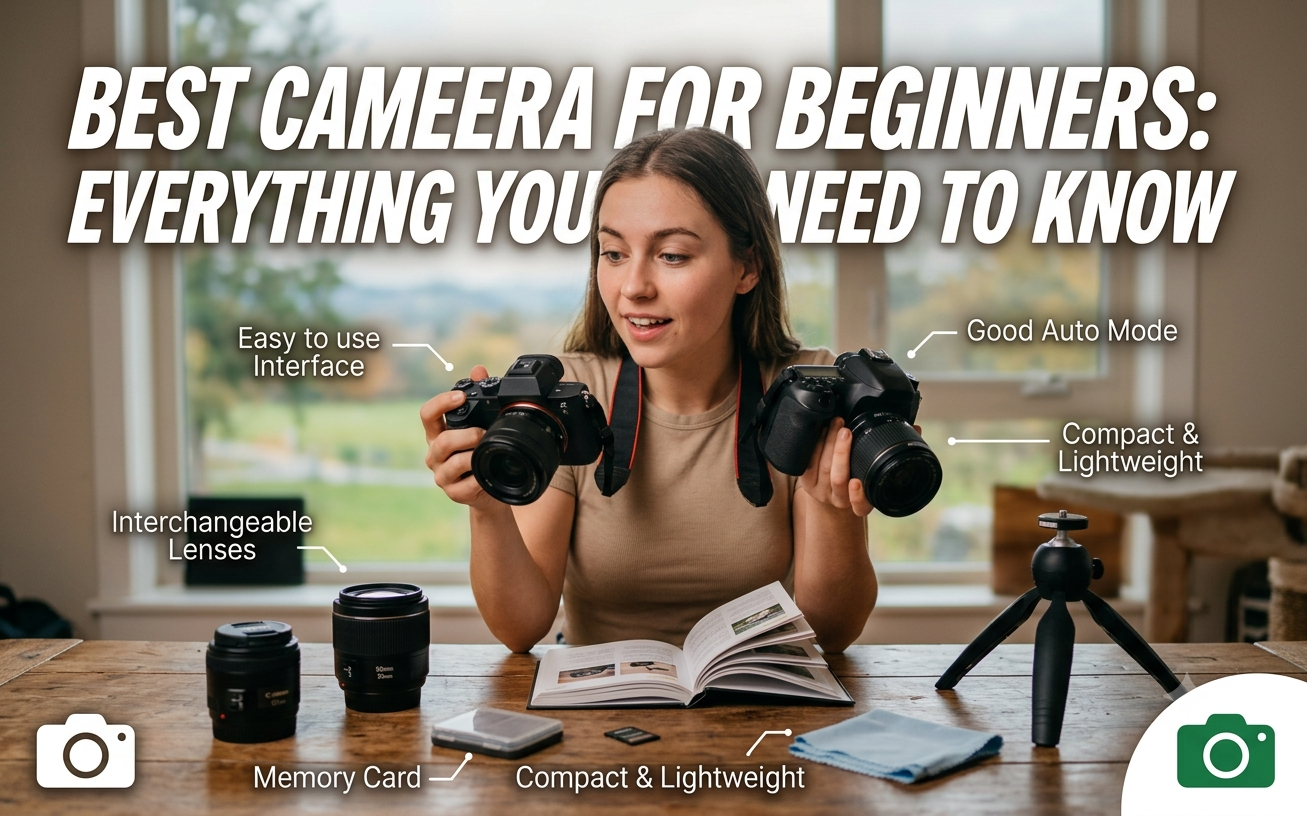
The camera body is not the whole picture. When you factor in a kit lens or a first prime lens, a memory card, a spare battery, and a bag or strap to carry it all in, you should be thinking about the total system cost rather than just the body price.
As a rough guide, if your total budget is around $1,000, spending $600 to $700 on a camera body leaves you $300 to $400 for a quality lens. That is the right balance. A better lens on a modest camera body will consistently produce better images than a great camera body paired with a cheap lens. The lens is actually more important than the body in many situations, because it determines the optical quality of light reaching the sensor, the aperture range available to you, and how much background blur you can achieve.
The accessories you actually need are simple. A fast memory card (at minimum a UHS-I Class 10 card, with 64 to 128 gigabytes being a practical size for most beginners), a spare battery (almost every beginner camera has disappointing battery life), and something to carry the camera in when you are not shooting. You do not need a UV filter, a polarizing filter, a remote trigger, a tripod immediately, or any of the other accessories that get bundled into starter kits at inflated prices.
If you are spending more than about $1,200 total on your first camera setup, you are probably overinvesting before you know what you actually want. The better approach is to start with a sensible APS-C body and one good lens, learn that combination thoroughly over several months, and then add to your kit based on what you discover is missing rather than what the internet tells you that you need.
The Mistake That Costs People the Most Money
Switching lens systems is the most expensive mistake a beginner photographer makes. It happens like this: someone buys a Canon camera because a friend recommended it, then discovers six months later that Fujifilm’s colors are more to their taste, or that Sony’s autofocus is faster, or that Nikon’s ergonomics feel better in their hands. So they sell the Canon and buy into a different system. Every lens they bought for Canon is now worthless to them or has to be sold at a significant loss. Switching mounts typically costs photographers 40 to 60 percent of their lens investment.
The way to avoid this is to handle cameras before you buy. Visit a camera store if one is accessible to you, and ask to hold the bodies you are considering. The way a camera sits in your hand, where the controls fall under your fingers, how the menus feel to navigate, these things matter more over time than almost any spec comparison. A camera that feels natural to use is one you will reach for instinctively. A camera that feels awkward is one you will leave at home.
If a store visit is not possible, research which brands share lens mounts. Sony’s E-mount, for example, is shared between their APS-C cameras and their full-frame cameras, meaning every Sony E-mount lens works on every Sony camera. This is the deepest and most flexible ecosystem available. Fujifilm’s X-mount is similarly comprehensive for APS-C. Canon’s RF-mount covers both their crop-sensor and full-frame mirrorless cameras but does not yet support third-party autofocus lenses for full-frame bodies (as of 2026). Nikon’s Z-mount is deep for full-frame but has fewer native APS-C options. Understanding these differences before you buy will save you real money.
What Actually Makes Your Photography Better
This section is more important than any camera recommendation in this guide, because it addresses the thing that actually separates photographers who keep getting better from those who plateau and give up.
The camera does not make the photograph. The photographer does. And the difference between someone who gets genuinely beautiful images and someone who gets mediocre ones with the same camera is almost entirely about understanding light.
Light is the most important element in any photograph. The quality of light, its direction, its hardness or softness, the color it casts at different times of day, these things change everything about how a photo feels. The golden hour, the period shortly after sunrise and before sunset, is called that for a reason. The light is warm, soft, and directional in a way that makes almost any subject look more beautiful. Shooting at midday in direct sunlight produces harsh, flat images that are difficult to make look good regardless of camera settings.
Learning to see light is a skill that develops through practice, and the best way to practice is to photograph the same subject in different lighting conditions and compare the results. Not different subjects every time, which teaches you variety but not depth. The same subject, in the same location, at different times of day and in different weather. You will learn more from that exercise than from any number of photography courses or gear purchases.
The second thing that will improve your photography dramatically is understanding composition. How you arrange the elements within a frame determines whether an image is interesting or boring, whether it draws the eye where you want it to go or lets the viewer get lost. Simple compositional principles like the rule of thirds, leading lines, framing within the frame, and negative space are starting points that every serious beginner should understand. Not rules to follow mechanically, but ideas to internalize so that you eventually break them purposefully.
For a deeper technical guide to how beginner cameras compare across brands and sensor systems, the DPReview buying guide is updated regularly by people who test cameras professionally and offers some of the most reliable comparative data available. And for a more philosophical take on what actually matters when choosing your first camera, Fstoppers’ guide to what actually matters for beginners in 2026 cuts through the noise in a way that most manufacturer-influenced buying guides do not.
A Practical Recommendation Based on Where You Are
If you want the best beginner camera available and your budget can stretch to around $900, the Canon EOS R10 is the clearest recommendation. It teaches well, the autofocus is extraordinary for its class, and the Canon RF ecosystem gives you a genuine long-term path.
If you want something simpler and lighter for around $750 and you are not interested in mastering a complex camera right away, the Canon EOS R50 is the more beginner-friendly choice. It will make you look better with less effort and is an absolute joy for video.
If you want a camera you can grow with for years and plan to invest in photography seriously over time, the Nikon Z50 II offers longevity and system depth that neither Canon option matches at this price point.
If you are drawn to creative, film-inspired photography and want a camera that feels deeply satisfying to use beyond just its output, the Fujifilm X-S20 is in a class of its own for the experience it provides. It is the camera that people tend to keep even after they upgrade other parts of their kit.
If your budget is tight and you are still figuring out whether photography is something you want to pursue seriously, find a used Canon Rebel T7 or Nikon D3500 in good condition. Learn it, fall in love with photography, and then decide which modern mirrorless system to invest in with full knowledge of what you want.
Whatever you choose, the most important thing is this: buy it, go outside, and start shooting. Every hour spent comparing cameras on the internet is an hour you could have spent making images and learning something real. The camera that makes you a photographer is the one you already have in your hands.
Final Thoughts
The photography market in 2026 is genuinely excellent for beginners. The cameras available at entry-level prices today would have been considered professional tools a decade ago. Any of the cameras in this guide will take images that can stop someone scrolling and make them look twice.
What they cannot do is do the seeing for you.They cannot notice that the light coming through the window is extraordinary for the next twenty minutes.They cannot decide that the person across the table has an expression worth capturing right now.They cannot tell you to crouch down and change the angle to get the street sign out of the background. That is all you. And that is what makes photography interesting. The camera is just the tool. Your eye is the thing that matters.
Buy something reasonable, stay curious, and keep shooting.