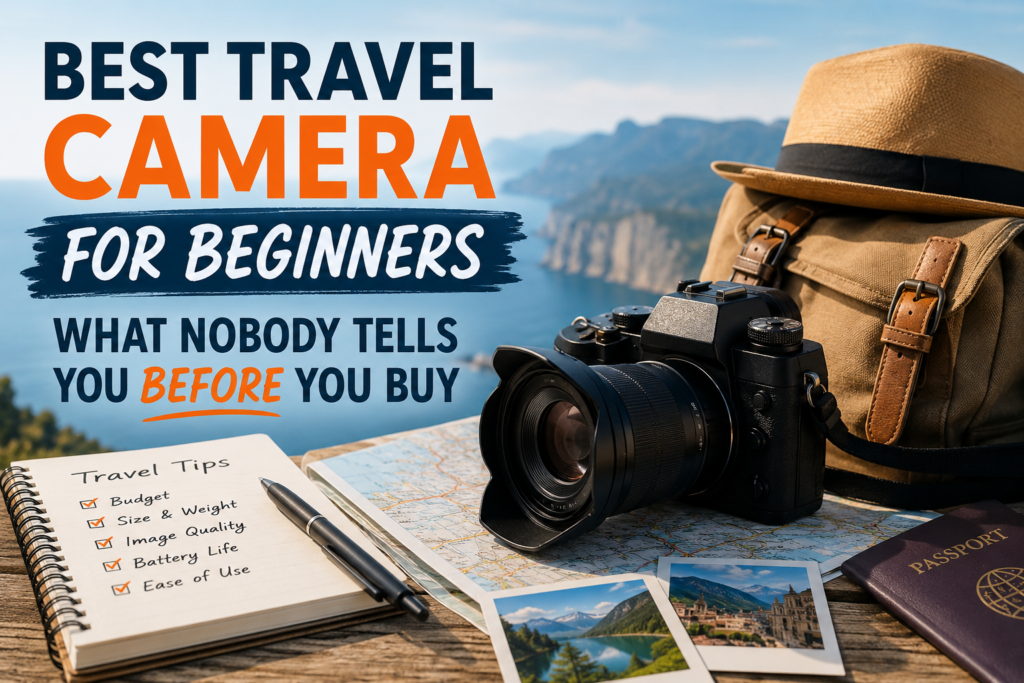
You are standing at the edge of a viewpoint somewhere in the mountains, or maybe it is a narrow alleyway in an old European city, and your phone just does not cut it. The photo looks fine on a screen, but when you actually zoom in, everything is muddy, the colors feel flat, and the moment you wanted to hold onto forever has lost something in translation. That is usually the point where most people start thinking about getting a real camera.
But then comes the confusion. There are about a hundred different cameras marketed at beginners, each with its own set of numbers and letters that mean almost nothing unless you have spent years in photography circles. You start reading reviews and suddenly you are drowning in comparisons between sensors you have never heard of, autofocus systems explained in jargon, and prices that range from mildly alarming to completely unreasonable.
This article is here to fix that. It is written for someone who genuinely wants to understand what they are buying and why, not just a list of products with a bunch of specs copied from a manufacturer’s website. Let us actually talk about what matters when you are a beginner picking your first travel camera in 2026.
Why a Dedicated Camera Still Makes Sense in 2026
This is a fair question to ask. Smartphones have gotten genuinely impressive. The iPhone 16 Pro, Google Pixel 9, and Samsung Galaxy S25 Ultra all take photos that would have been unthinkable from a phone just five years ago. So why carry a separate camera at all?
The honest answer is that a dedicated camera still wins in ways that matter to travel photography. The biggest of these is sensor size. A phone sensor, no matter how well the software processes it, is physically small. That means it struggles in low light, it has limited dynamic range, and it cannot separate a subject from a background in the same way a camera with a larger sensor can. When you are shooting a candid portrait in a dimly lit restaurant in Tokyo or trying to capture the last light of sunset over the Sahara, that difference becomes very obvious very fast.
Beyond image quality, dedicated cameras give you actual control. You can adjust your aperture, shutter speed, and ISO in a way that teaches you photography as you go. Every time you adjust these settings and see the result, you learn something. You cannot get that education from a phone camera that is making all the decisions for you.
The other thing nobody talks about enough is the experience of shooting with a real camera. It changes how you engage with a place. You slow down, you look more carefully, and you think more intentionally about what you are capturing. That shift in mindset often leads to better memories, not just better photos.
The Camera Market Has Changed Completely
Up until a few years ago, the standard advice for beginners was to get a DSLR. Those big, chunky cameras with optical viewfinders were the reliable entry point for anyone serious about photography. They worked well, the batteries lasted forever, and there were plenty of affordable lenses available.
In 2026, that advice is outdated. Mirrorless cameras have taken over the market almost entirely. The major manufacturers stopped developing new DSLRs, and the mirrorless systems have matured to the point where there is no meaningful reason for a beginner to choose a DSLR when buying new. Mirrorless cameras are smaller, lighter, and in most cases, better in the ways that matter for travel. If you find a used DSLR at a good price and it appeals to you, it can still be a fine camera. But if you are buying new today, go mirrorless.
The sweet spot for beginners in 2026 is what the industry calls an APS-C mirrorless camera. For a broader overview of what to look for when choosing a beginner camera, APS-C refers to the sensor size, which is meaningfully larger than a phone sensor but smaller than a full-frame sensor. This size gives you excellent image quality, a wide range of affordable lenses, and a compact body that does not feel like you are lugging a professional kit around all day. It is genuinely the right starting point for almost every beginner.
What to Actually Look For in a Travel Camera
Before getting into specific camera recommendations, it helps to understand what features actually matter and which ones you can mostly ignore as a beginner.
Sensor size is the single most important factor in image quality. APS-C sensors, as mentioned, are the right place to start. They capture significantly more light than a phone sensor and produce images with much better depth, color accuracy, and detail. Full-frame sensors are larger and produce even better results, but the cameras and lenses cost considerably more. As a beginner, APS-C gives you everything you need to make genuinely great images without paying a premium for capabilities you will not use for years.
Autofocus is more important for travel photography than most beginners expect. When you are shooting street scenes, people moving through a market, or even just a friend walking toward you, you need a camera that can lock focus fast and keep it. Modern mirrorless cameras use phase detection autofocus systems that are dramatically better than what was available even five years ago. Most cameras in the beginner range today have subject recognition, meaning the camera can identify faces, eyes, and sometimes even animals and vehicles, and focus on them automatically. This is one of those features that sounds like marketing until you actually use it and realize how many sharp photos you are getting of subjects you would have missed with an older system.
In-body image stabilization, often shortened to IBIS, helps reduce camera shake, especially in low light situations. Not every beginner camera has it, and it is not a dealbreaker if one does not, but it is a genuinely useful feature when you are shooting handheld in dim conditions without a tripod.
Battery life is something beginners almost always underestimate. When you are out all day exploring a city or hiking to a viewpoint, you do not want to carry three spare batteries or be hunting for a charging spot by noon. Some cameras in the entry-level range have batteries that will only give you around 250 to 300 shots per charge, which sounds like a lot but goes faster than you expect. Cameras with better battery life, getting 400 or more shots per charge, are worth paying attention to.
Weight and size matter more on a trip than they do in a camera store. A camera that feels fine to hold for ten minutes in a store can feel very different after four hours of walking through cobblestone streets with it around your neck. For travel specifically, lighter and smaller is almost always better. This is one of the reasons mirrorless cameras have become so popular. They deliver serious image quality without the bulk of older DSLR systems.
The Best Travel Cameras for Beginners Right Now
Canon EOS R50
The Canon EOS R50 is probably the easiest recommendation for most beginners in 2026. It is priced under $800 with a kit lens, and it manages to pack a genuinely impressive set of features into a very compact body. The 24.2 megapixel APS-C sensor produces sharp, vibrant images with good dynamic range, and Canon’s color science has always been regarded as natural and pleasing straight out of the camera.
What really makes the R50 work for beginners is how thoughtfully it is designed. The fully articulating touchscreen flips forward for selfies or vlogging and can tilt to almost any angle, which is incredibly useful when you are shooting from awkward positions. The menus are clean and logical, and the autofocus is powered by Canon’s Dual Pixel CMOS system, which is among the best in its class. It locks onto faces and eyes quickly and holds focus reliably through movement. For 4K video, which has become important for many travelers who want to document their trips on social media or YouTube, the R50 delivers clean, detailed footage at 30 frames per second.
The main compromises are worth knowing. The R50 does not have in-body image stabilization, so you are relying on optically stabilized lenses or keeping a steady hand. It also is not weather-sealed, meaning you need to be careful in rain or dusty environments. The buffer for rapid burst shooting is limited, so it is not ideal for action photography. But for landscape shots, street photography, portraits of people you meet on the road, and travel vlogging, it is hard to beat at this price.
Fujifilm X-T50
The Fujifilm X-T50 is a different kind of camera, and for certain travelers it is the more exciting option. It houses a 40 megapixel APS-C sensor in a compact, retro-styled body that looks more like a film camera from the 1970s than a modern digital camera. This actually matters when you are traveling, because a camera that looks less imposing tends to attract less attention, and people often feel more comfortable being photographed by something that does not look threatening or expensive.
What makes Fujifilm cameras genuinely special for beginners is the film simulation feature. These are preset color profiles built into the camera that mimic the look of classic Fujifilm film stocks. You can shoot in Velvia for rich, saturated landscapes, or in Classic Chrome for a muted, documentary style, or in Provia for natural, balanced color. These simulations mean you can produce beautiful, distinctive JPEGs straight out of the camera without touching editing software. For beginners who do not yet know how to edit RAW files, this is a real advantage.
The X-T50 also has in-body image stabilization, which the Canon R50 lacks. Its 40 megapixel sensor gives you a lot of resolution to work with, meaning you can crop significantly into an image and still have plenty of detail. The camera is lightweight and compact, making it a natural travel companion.
The downsides are that it does not have weather sealing, the joystick and some of the buttons can feel cramped for people with larger hands, and the battery only lasts around 300 shots per charge, which is on the lower end. The autofocus is good but not quite as snappy in complex tracking situations as the Canon. None of these are dealbreakers, but they are worth knowing.
Nikon Z50 II
The Nikon Z50 II is often overlooked in conversations about beginner travel cameras, but it deserves more attention than it gets. Released in late 2024, it is priced below $1000 with a kit lens, has a solid 20.7 megapixel APS-C sensor, and comes with one feature the other two cameras on this list do not have: weather sealing.
For travelers who plan to shoot in variable conditions, whether that means hiking in foggy mountains, shooting at the beach where salt spray is a concern, or just being out in light rain, weather sealing offers real peace of mind. It means you do not have to stop shooting the moment a cloud opens up. You can keep working in conditions that would force you to pack away an unsealed camera.
The Z50 II has a viewfinder, which some photographers prefer over shooting solely with a rear screen, especially in bright sunlight where screens can be hard to read. Its autofocus is reliable and competent, though the lens selection for Nikon’s Z system is still growing and not as comprehensive as what is available for Canon RF or Fujifilm X mount. If you are thinking about building a more expansive system over time, this is worth considering.
The battery life is the main pain point, as it gets around 250 shots per charge, which is the weakest of the three cameras discussed here. Carrying a spare battery is essentially mandatory.
Sony RX100 VII: The Compact Wild Card
Not everyone wants to deal with interchangeable lenses. If the idea of swapping lenses and building a lens collection sounds overwhelming or just unnecessary for how you plan to travel, a compact camera with a built-in zoom lens is a genuinely viable alternative.
The Sony RX100 VII is the best option in this category by a noticeable margin. It has a one-inch sensor, which is smaller than APS-C but much larger than a phone sensor, paired with a 24 to 200 millimeter equivalent zoom lens. That zoom range covers wide cityscapes, comfortable portrait distances, and enough reach to pull in distant subjects like wildlife or architecture. It fits in a jacket pocket, which no mirrorless camera can claim, and it has impressive autofocus for its size. The image quality is not quite at the level of an APS-C camera, but it is considerably better than a smartphone in most situations, and the convenience factor is real.
The price is higher than the Canon R50, which can feel counterintuitive since it is a smaller, simpler camera. But you are paying for engineering miniaturization and the quality of that zoom lens. If portability is your absolute top priority and you want one camera that does everything without any extra decisions to make, the RX100 VII earns its price.
How Much Should You Spend?
The honest answer is that you do not need to spend a lot to get a camera that will genuinely impress you. The Canon EOS R50 with a kit lens sits around $750, and at that price it delivers image quality and features that were only available in cameras costing twice as much a few years ago.
You should budget for at least one extra battery, a decent memory card, and a bag or strap that keeps the camera accessible without being uncomfortable. None of these accessories need to be expensive, but they all make a real difference in how often you actually use the camera.
Buying a used mirrorless camera is also worth considering if budget is a concern. The previous generation Fujifilm X-T30 II or an older Sony a6400 can be found in excellent condition for significantly less than new models, and they still produce outstanding images by any standard that matters to a beginner.
For an excellent deep dive into how camera systems compare across price ranges and sensor formats, the DPReview buying guide for travel cameras is one of the most detailed and technically rigorous resources available. It is updated regularly and written by people who actually test these cameras in real shooting conditions.
A Few Things Beginners Usually Figure Out Too Late
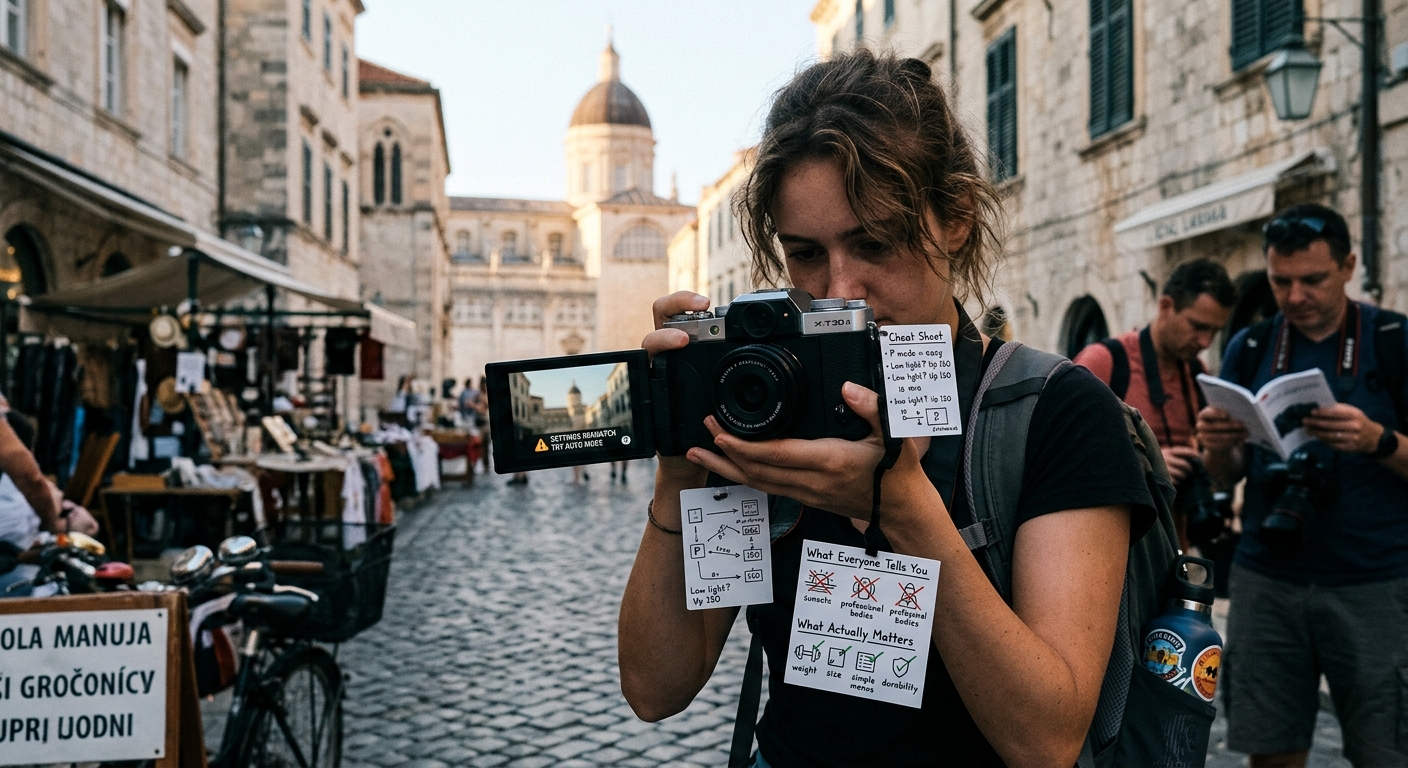
Getting the camera is only half the equation. The way you actually improve as a photographer is by shooting in manual or semi-manual modes and learning why your photos look the way they do. Most beginners stay in full auto for too long, and while full auto will get you decent photos, it will not teach you anything.
Start by switching to aperture priority mode, labeled as A or Av on most cameras, and experiment with different aperture settings. A wider aperture, expressed as a lower f-number like f1.8 or f2.8, blurs the background and isolates your subject. A narrower aperture like f8 or f11 keeps more of the scene in focus. Once that concept clicks, you will start seeing creative possibilities in every scene you encounter.
Learning to shoot in RAW format rather than JPEG is another skill worth picking up early. RAW files give you far more flexibility when editing, allowing you to recover highlights, lift shadows, and adjust white balance in ways JPEG simply does not allow. It feels technical at first, but free software like Lightroom’s mobile app or RawTherapee makes it approachable even without editing experience.
If you want a perspective from someone who has shot in nearly every corner of the world and has tested almost every camera system available, the Finding the Universe travel camera guide is written by professional travel photographers and goes deep on real-world experience with each camera.
The Right Camera Is the One You Will Actually Carry
This is the most important thing to take away from any camera buying guide. The best camera is not the one with the most megapixels or the longest feature list. It is the one you bring with you on every trip, pull out in the moment, and feel comfortable using.
A smaller, lighter camera that you take everywhere will produce more great photos than a larger, more capable camera that stays in your bag because it is too heavy or complicated. Weight and size genuinely matter. Simplicity matters. Enjoying the experience of using it matters.
For most beginners in 2026, the Canon EOS R50 hits the best combination of image quality, ease of use, video capability, and price. If Fujifilm’s aesthetic and film simulations appeal to you, the X-T50 is a genuinely inspired choice that you will enjoy shooting with in a different way. If you are going to extreme environments and weather sealing is important, the Nikon Z50 II gives you peace of mind that the other two do not. And if you want true portability above all else, the Sony RX100 VII fits in a pocket and covers nearly every focal length you will need.
Pick the one that fits how you actually travel, get out with it, and start shooting. The rest you will figure out along the way.